Advanced Tungsten Carbide & Carbide-Based Coatings at Hannecard
At Hannecard, continuous investment in advanced surface technologies ensures customers receive high-performance coatings that improve durability, reliability, and operational efficiency.
To further strengthen its thermal spray capabilities, Hannecard has recently commissioned new state-of-the-art equipment, including robotic spray technology and an advanced High Velocity Liquid Fuel (HVLF) thermal spray system. These upgrades significantly enhance coating precision, production efficiency, and overall coating quality for a wide range of industrial applications.
New Robotic Spray Technology for Precision Coating
A key addition to the facility is the robotic system with a cutting edge controller and advanced software. This industrial robot supports highly controlled and repeatable spray movements during the coating process.
The robotic system improves coating performance in several important ways. Precision-controlled movement ensures uniform coating thickness across the entire component surface, which is essential for achieving consistent wear protection and predictable performance in demanding environments.
Automation also enhances operator safety by enabling remote spray operations. Thermal spray processes occur at extremely high temperatures, and robotic systems allow these operations to be managed safely and efficiently while maintaining precise application control.
Additionally, robotic automation allows for longer continuous operating cycles and improved process stability. This results in more consistent coatings and higher production throughput, particularly for large industrial rolls and components requiring complex spray patterns.
Installation of the Thermal Spray System
Hannecard has also expanded its coating capabilities with the installation and commissioning of a High Velocity Liquid Fuel thermal spray system.
The system represents a third-generation kerosene-fuelled HVOF/HVLF technology widely adopted in Europe for high-performance coating applications. The system incorporates patented kerosene atomization technology and an advanced combustion chamber design that produces extremely stable spray conditions.
Higher combustion pressure within the system allows powder particles to reach very high velocities before impacting the substrate. These high-velocity impacts create dense, strongly bonded coatings with superior mechanical performance and wear resistance.
The system also includes a membrane kerosene pump that ensures consistent fuel flow, contributing to stable combustion and reliable coating quality throughout the spray process. In addition, the dual hopper powder feed system provides more consistent powder delivery, improving coating reproducibility during high-volume production.
Enhanced Capabilities for Carbide Coatings
The Thermal Spray system enables Hannecard to apply a wide range of advanced carbide coatings, including tungsten carbide and chrome carbide materials commonly used in high-wear industrial applications.
These coatings provide several performance advantages, including superior wear resistance, excellent corrosion protection, high bond strength, dense coating structures with very low porosity, and improved surface finish quality.
The system also supports multiple spray gun configurations, allowing the processing of materials that require high heat input—such as carbide and cermet coatings—as well as lower melting-point materials.
Together, these capabilities allow Hannecard to deliver coating solutions tailored to the exact requirements of each application.
What Are Tungsten Carbide Coatings?
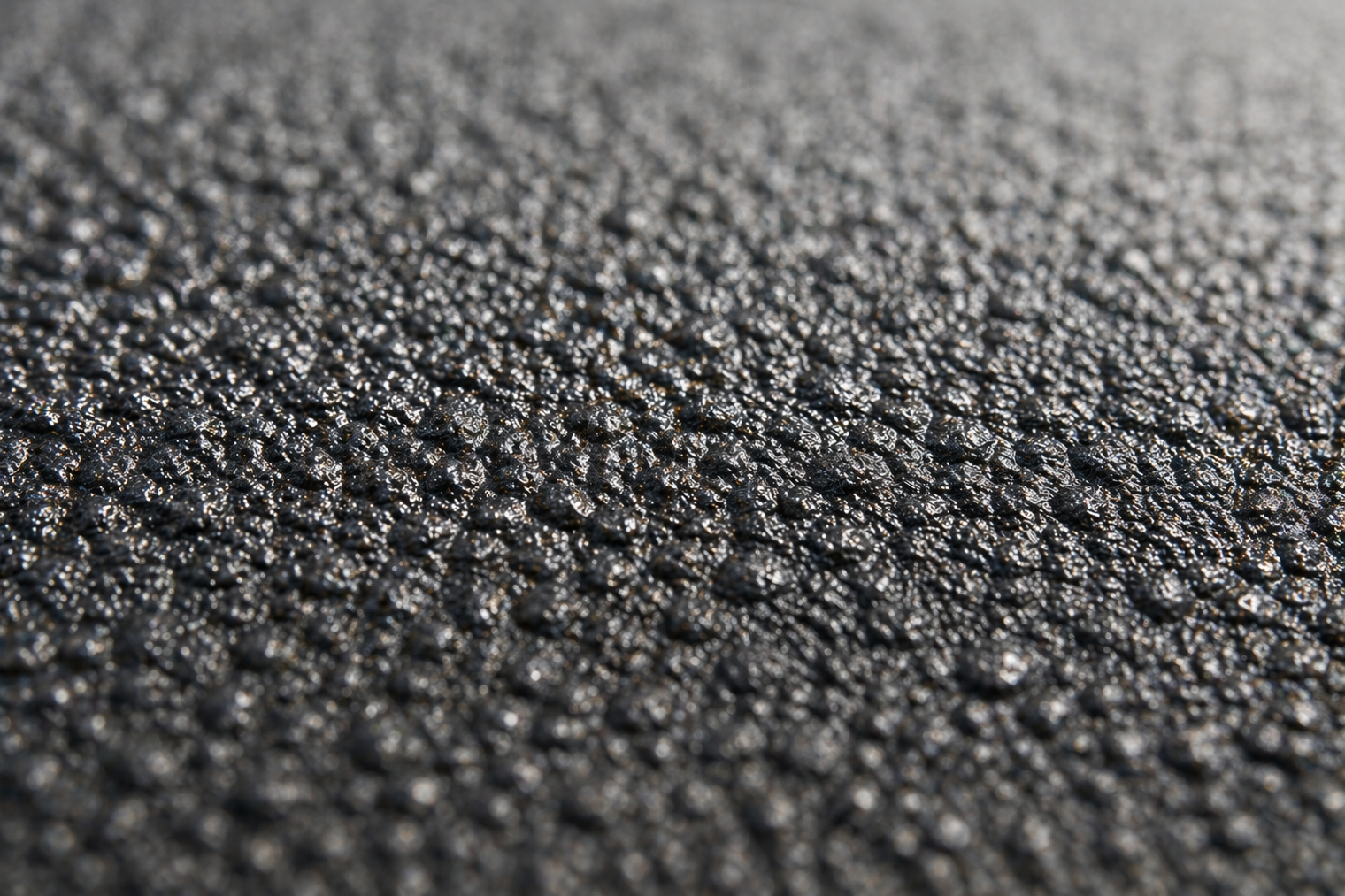
Tungsten carbide is a chemical compound consisting of equal parts tungsten and carbon atoms. It is one of the hardest materials used in industrial surface engineering, with hardness levels comparable to corundum.
The material also offers exceptional resistance to abrasion, erosion, and mechanical wear. Because of these properties, tungsten carbide is widely used in coatings designed to protect components operating under severe mechanical and environmental conditions.
When tungsten carbide is applied through high-velocity thermal spray processes, the coating bonds strongly to the substrate, creating a durable and highly wear-resistant surface layer.
How the Thermal Spray Process Works
In the HVOF/HVLF thermal spray process, fuel and oxygen are combusted within a high-pressure chamber to generate extremely hot gases. These gases are accelerated through a nozzle, creating a high-velocity stream.
Powdered coating material, such as tungsten carbide, is injected into this gas stream where the particles are rapidly heated and accelerated toward the component surface at supersonic speeds.
When the particles strike the substrate, their velocity drops instantly and their kinetic energy causes them to deform and bond to the surface. Subsequent particles arrive in rapid succession, building up a dense, cohesive coating layer.
Because of the extremely high particle velocities generated, the resulting coatings typically exhibit very low porosity along with high bond strength and excellent wear resistance.
Tailoring Coating Performance
The performance of tungsten carbide coatings can be adjusted by controlling the grain size of the carbide particles and the ratio between the carbide phase and the metallic binder.
These parameters influence several important coating properties, including hardness, wear resistance, surface finish, and toughness. By carefully selecting the appropriate feedstock materials and spray parameters, coatings can be optimized for the specific operating conditions of each component.
This flexibility allows Hannecard to design coatings that meet the exact performance requirements of applications ranging from high-load mechanical systems to corrosive process environments.
Advanced Finishing and Production Capabilities
In addition to its advanced spray equipment, Hannecard maintains a wide range of finishing and production capabilities to ensure precise coating performance.
These capabilities include high-pressure piston diamond grinding, diamond super-finishing equipment, large turning capacity for industrial rolls and components, custom fixturing for repeatable production, and specialized masking systems to protect critical areas during coating.
Together, these technologies ensure that coated components meet strict dimensional tolerances and surface finish requirements.
Applications for Tungsten Carbide Coatings
Tungsten carbide coatings are widely used in industries where equipment must operate under severe wear, abrasion, or corrosion conditions.
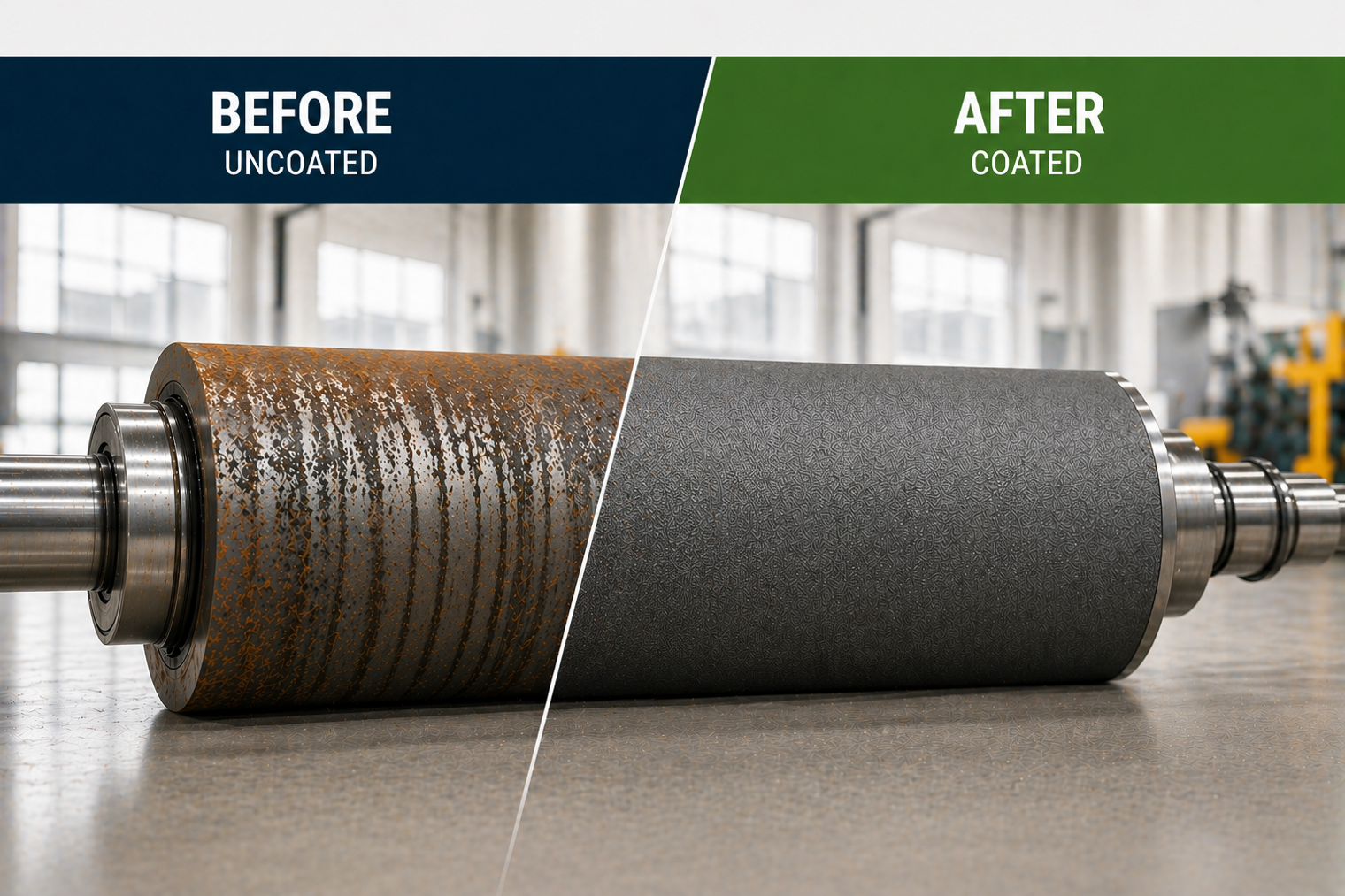
Typical applications include paper and converting industries, where wear-resistant coatings improve roll grip performance and extend service life; steel and metals production, where coatings protect components throughout the manufacturing process; power generation, where equipment must withstand abrasive materials such as coal; and custom industrial components such as hydraulic pistons, pump components, and rotating shafts that require enhanced durability.
Delivering High-Performance Coating Solutions
With the integration of advanced robotic automation and the thermal spray system, Hannecard has significantly strengthened its ability to deliver high-performance carbide coatings with exceptional consistency and reliability.
These investments reflect the company’s ongoing commitment to technological innovation, production efficiency, and delivering long-lasting coating solutions that improve component service life and operational performance.
For customers facing demanding wear challenges, Hannecard provides advanced thermal spray expertise and coating technologies designed to maximize equipment reliability and productivity.